
How to Combine Speed Reading With Mind Mapping
Like a skilled painter who masterfully blends colors on a canvas, you can combine speed reading with mind mapping to create a vivid understanding of complex material. By chunking information and organizing it visually, you not only enhance your comprehension but also create a framework for recalling critical concepts. However, the real challenge lies in finding the most effective techniques to seamlessly integrate these two methods. What strategies can you employ to transform a chaotic flow of information into a structured masterpiece?
Understanding Speed Reading

Speed reading transforms the way you consume information, allowing you to grasp content at a pace much faster than the typical 200-400 words per minute. With practice, you can achieve speeds of 1000-1700 words per minute. This isn't just about reading faster; it's about understanding more efficiently. You'll learn Speed Reading Techniques that let you read in chunks instead of word-for-word, boosting your comprehension. Active reading enhances reading speed, which is essential for maximizing your retention of material.
One powerful method involves creating Memory Palaces. Imagine walking through a familiar place and placing visual representations of what you're reading in specific spots. This technique enhances your ability to recall information. Additionally, combining speed reading with Mind Mapping can deepen your understanding of complex topics. By visualizing the connections between ideas, you'll find it easier to absorb and retain information.
Be mindful of common habits like subvocalization and regression, which can slow you down. Instead, focus on enhancing your visualization skills and grasping context quickly. As you practice these strategies, your reading efficiency will improve, making you a more effective learner. Embrace the journey of mastering speed reading, and watch your ability to process information transform.
Benefits of Mind Mapping
When you use mind mapping, you're not just organizing information; you're enhancing your visual learning experience. By mapping out concepts, you can quickly see how different ideas connect, making it easier to grasp complex topics. Plus, this approach boosts your retention, so you'll remember what you read much better than if you were just skimming through text.
Visual Learning Enhancement
Mind mapping transforms the way you absorb information, especially when it comes to visual learning. By creating a graphical representation of ideas, you simplify complex concepts and clarify their relationships. Imagine using colors, images, and symbols in your mind maps; research shows these elements can greatly enhance your memory retention and recall. You'll find that when you engage with mind maps, your motivation and engagement soar compared to traditional note-taking methods.
As you plunge into speed reading, mind mapping becomes your ally. It helps summarize information into concise visual formats, making it easier to absorb and recall critical details. Think of it like a Memory Palace, where each idea is a room filled with vivid images that stick in your mind. This method encourages you to identify connections between ideas, promoting deeper comprehension and critical thinking skills.
Concept Relationship Visualization
Concept relationship visualization is a powerful tool that can elevate your understanding of complex subjects. When you use mind mapping alongside speed reading, you create a dynamic way to visualize ideas and their connections. Each branch of your Memory Map reveals how concepts relate, making it easier for you to grasp the big picture.
Incorporating colors, symbols, and images into your maps not only makes them visually appealing but also enhances your memory retention. This active engagement with the material helps you move beyond passive reading. By summarizing dense information into a single mind map, you considerably reduce the cognitive load, allowing for quicker access to important points.
As you explore different topics, mind maps help you see how new information integrates with what you already know. This process deepens comprehension and boosts retention rates. So, when you combine speed reading with concept relationship visualization, you're actively participating in your learning journey. Embrace this method, and watch how your understanding of complex subjects transforms. You'll find that steering through intricate ideas becomes a more accessible and enjoyable experience.
Information Retention Improvement
Harnessing the power of visual organization, mind mapping greatly boosts your ability to retain information. When you create mind maps, you're not just jotting down notes; you're visually organizing complex concepts. This helps you understand the relationships between ideas, which can greatly improve your recall. By incorporating colors, images, and symbols, your mind maps become vibrant tools that stimulate memory, making it easier to retrieve information later.
Summarizing chapters into mind maps also allows you to compress material, facilitating quicker reviews and enhancing your retention of key points. Research shows that blending memory techniques with mind mapping can lead to higher retention rates and better recall accuracy. So, when you speed read, follow up with a mind map to reinforce what you've just learned.
Regularly engaging with mind maps during your study sessions strengthens your memory pathways. This means you'll not only remember the material better, but you'll also gain a deeper understanding. Embrace this powerful combination of speed reading and mind mapping, and watch your information retention soar. You'll find that studying becomes not just more effective, but also more enjoyable.
Techniques for Effective Combination

To effectively combine speed reading with mind mapping, you can start by chunking information into manageable parts. This approach helps you quickly absorb key concepts, which you can then visually organize in a mind map. Additionally, using color coding and images can enhance your memory of these points, making it easier to recall what you've learned later on.
Chunking Information Efficiently
Chunking information efficiently transforms the way you process and retain reading material. By breaking down text into smaller, manageable pieces, you can enhance your reading speed and comprehension. When you read, try grouping related ideas together. This technique not only helps you create mental images but also sets the stage for effective mind maps later on.
As you practice chunking, you'll notice a reduction in subvocalization—those little voices in your head that focus on each word. Instead, you can hone in on larger phrases or concepts, making your reading experience smoother. Once you've identified the main ideas, grab a piece of paper and start creating mind maps. They visually organize the connections between those ideas, reinforcing your understanding and making recall easier.
Combining chunking with mind maps can greatly boost your retention rates. You'll find that your overall learning experience becomes more enjoyable and efficient. So, immerse yourself in this process with an open mind, and watch how your ability to absorb information flourishes. Embrace the power of chunking information and mind mapping to elevate your reading game!
Visual Memory Enhancement Techniques
There are various visual memory enhancement techniques you can use to boost your learning when combining speed reading and mind mapping. One effective method is to incorporate colors, images, and symbols into your mind maps. This not only stimulates your visual memory but also makes recalling information from your speed reading much easier.
After you finish a reading session, try summarizing key points into a mind map. This practice reinforces your understanding and retention of the material. Before you explore speed reading, survey the material to create a mental framework. This can later be expanded into a detailed mind map, optimizing how you process information.
It's also beneficial to revisit and revise your mind maps regularly. Doing this can considerably improve your long-term retention and recall of the information you've absorbed. By focusing on visual memory alongside speed reading techniques, you create a dynamic learning experience that enhances comprehension. So, grab your colored pens and start mapping out those ideas. You'll find that the blend of speed reading and mind maps not only makes learning enjoyable but also deeply effective.
Enhancing Retention With Mind Maps
How can mind maps transform the way you retain information? By visually organizing your thoughts, mind maps help you see the connections between concepts, making it easier to grasp and remember what you've read. When you create a mind map after speed reading, you condense key points, allowing for quicker recall of the material. This technique boosts your retention by 20-30%, as the visual elements reinforce your memory pathways.
Incorporating colors, images, and symbols in your mind maps can engage your senses, deepening your connection to the material. Each element adds another layer to your understanding, making it more memorable. Plus, regularly revisiting and updating your mind maps after speed reading sessions can considerably enhance long-term retention.
Think of mind mapping as a powerful tool in your learning arsenal. It's not just about reading faster; it's about retaining what matters. With these techniques, you'll reveal a new level of comprehension that makes studying feel less intimidating and more effective. So grab your markers and start mapping your way to enhanced retention today!
Practical Applications in Learning
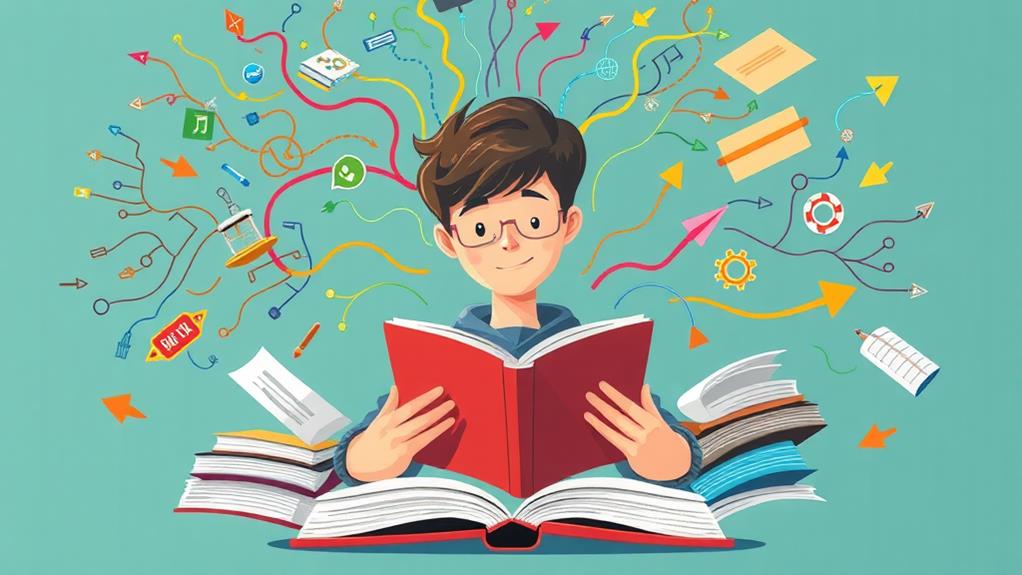
Integrating speed reading and mind mapping offers practical applications that can revolutionize your learning experience. When you combine these techniques, you quickly absorb information while also visualizing it, transforming abstract concepts into structured images. This visual representation is key to enhancing your memory.
As you read in chunks and scan for context, you can summarize main ideas using mind maps. This not only organizes your thoughts but also makes it easier to recall material during reviews. Research shows that mind mapping alongside speed reading greatly boosts comprehension, as the layout helps you connect ideas rapidly.
Tips for Improved Comprehension
Improving your comprehension while speed reading requires a few strategic approaches. First, practice reading in chunks. This technique helps you process multiple words at once, making it easier to retain information. Instead of getting bogged down by individual words, you'll find that your comprehension improves as you grasp phrases and ideas more holistically.
Next, consider integrating mind mapping after your speed reading sessions. Creating a mind map allows you to visualize and organize key concepts, deepening your understanding of the material. Use a Mind Map Overview to quickly identify relationships between ideas, which can enhance your recall and comprehension of complex topics.
Before you start reading, establish clear goals. This focus keeps you engaged with the content, leading to better comprehension outcomes. Finally, practice recalling information through your mind maps regularly. This reinforces memory retention, making it easier to retrieve information later on.
Overcoming Common Challenges

Speed reading can be a double-edged sword, bringing both benefits and challenges. You might find yourself reading too slowly at first, but practicing reading in chunks can greatly boost your speed. This technique allows for a smoother integration with mind mapping, helping you combine memory and understanding more effectively.
Regression, or back-skipping, is another common hurdle. If you catch yourself doing this, try using a pointer or your finger to guide your reading. This simple trick helps maintain focus and enhances your speed reading and mind mapping effectiveness.
Retaining information can also be tricky when combining these skills. After reading, employ the Mind Map Overview strategy to summarize key concepts. This approach reinforces what you've learned, making it easier to recall later.
Lastly, visualizing information is essential. If you struggle with this, think about incorporating objects or images into your mind maps. These visuals can enhance comprehension and link concepts together more effectively.
Resources for Further Learning
Building on the techniques you've learned, having the right resources at your fingertips can elevate your mastery of speed reading and mind mapping. Start by exploring online platforms like Coursera and Udemy, where you can find courses specifically designed to enhance your skills in both areas. These interactive lessons can deepen your understanding and keep you engaged.
Don't forget to check out Tony Buzan's books on mind mapping. They provide foundational knowledge and practical tips for organizing information efficiently. To take your mind mapping digital, apps like XMind and MindMeister are fantastic tools that visually structure the information you read, making it easier to retain.
For long-term retention, consider incorporating spaced repetition systems (SRS) like Anki. This method reinforces concepts learned through speed reading and mind mapping, ensuring they stick with you. Finally, joining online communities or forums dedicated to speed reading and mind mapping can be incredibly beneficial. These spaces allow you to exchange tips, resources, and experiences with fellow learners, creating a supportive environment for your growth. Embrace these resources, and watch your skills flourish!
Frequently Asked Questions
What Is Mind Mapping in Reading?
Mind mapping in reading creates a visual organization of ideas, helping you enhance cognitive retention. By structuring information hierarchically, you'll find it easier to recall key concepts and enjoy a deeper understanding of the material.
How Do You Take Effective Notes With Mind Maps?
To take effective notes, embrace mind mapping techniques, enhance your visual learning, and boost cognitive retention. Start with a central theme, branch out with key ideas, and use colors and symbols to engage your mind.
What Are the 7 Steps to Creating a Mind Map?
To create a mind map, start with your central idea, branch out key subtopics, use colors and images, connect related ideas, and review regularly. These creative brainstorming techniques enhance retention skills through visual thinking strategies.
What Is the Difference Between Memory Palace and Mind Mapping?
You'll find memory techniques like the Memory Palace and mind mapping cater to different learning styles. While the former enhances visual learning through spatial memory, the latter boosts cognitive enhancement by illustrating relationships among ideas.
